Browse guns
Collections
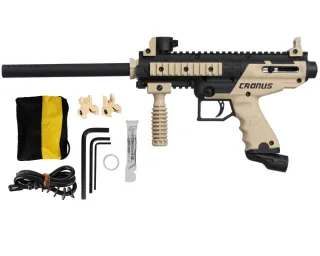
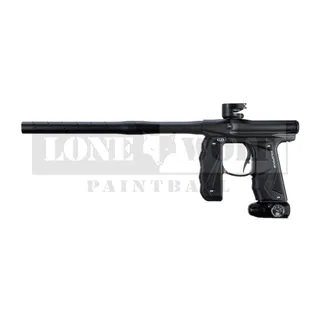
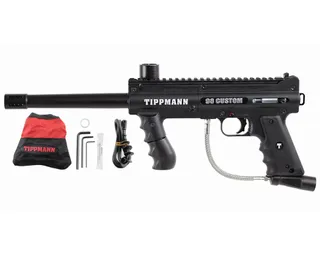
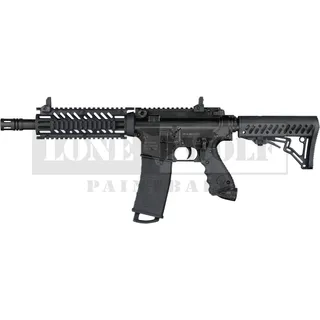
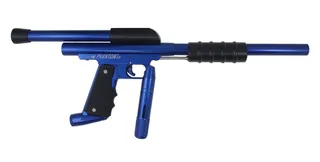













Tippmann Cronus Basic Paintball Gun
In Production
Tippmann Cronus Basic paintball gun: The default first-gun recommendation: a tank-tough inline blowback semi-auto that runs on CO2 or HPA and shrugs off abuse.
- Format: woodsball, rec
- Operation: Mechanical inline blowback
- Firing Modes: semi-auto
- Caliber: .68
- Feed: Gravity hopper
- Air: HPA/CO2
- Maintenance: Very Low
Typical street price: 60-110 (Budget). Pricing is guidance only.
We track new and used market prices for the Tippmann Cronus Basic and chart the weekly trend, so you can see how its value moves over time and spot the best time to buy.
Pros
- Extremely durable
- Cheap to buy and run
- Forgiving for new players
Cons
- Heavier than electronic guns
- Modest accuracy stock
- No firing-mode options
Inside the gun
How the Tippmann Cronus Works
The Cronus is a mechanical, open-bolt blowback gun, and on the inside it is very close to Tippmann's 98 Custom. Pull the trigger and a spring throws the rear bolt into the valve. The valve lets out a burst of air that fires the paintball, and part of that same burst shoves the rear bolt back until the sear catches it. There is no battery and no circuit board. Every shot cocks the gun for the next one.
The firing cycle, step by step
- Ready
The gun is cocked. The drive spring is squeezed between the end cap and the rear bolt, and the sear is hooked into a notch under the rear bolt to hold it back. The linkage arm ties the front bolt to the rear bolt, so the front bolt is back too. That leaves the breech open, and a paintball sits in it, fed down from the feed elbow. Between shots the bolt waits in the open position, which is what open bolt means.
- Release
On the Cronus the trigger sits well ahead of the sear, so the two are joined by a thin rod Tippmann calls the trigger linkage arm. Pulling the trigger pushes that rod back into the trigger adapter, which tips the sear down and out of the notch. Nothing is holding the rear bolt anymore.
- Chamber
The drive spring shoves the rear bolt forward, and the linkage arm drags the front bolt along with it. The front bolt slides forward over the power tube, pushes the paintball into the back of the barrel, and blocks the feed elbow so the next ball has to wait on top of the bolt.
- Gas pulse
At the end of its travel, the rear bolt slams into the valve stem that sticks out the back of the valve. That pushes the cup seal off the front valve seat for a split second. Tank air that was waiting in the valve, fed up through the gas line in the grip, rushes out, runs forward through the power tube and out the center of the front bolt, and drives the paintball down the barrel.
- Blowback
Not all of that air goes forward. Some of it escapes back around the valve stem into the space between the valve and the rear bolt, and it pushes the rear bolt backward, squeezing the drive spring again. As soon as the rear bolt pulls away from the stem, the valve spring closes the cup seal against the seat. That is the blowback in a blowback gun: the shot itself recocks the Cronus, so you only need the bolt handle for the first shot.
- Reset
On the way back, the rear bolt rides over the sear until the notch lines up, and the sear spring pops the sear up into it. The drive spring nudges the bolt forward onto the sear and it stops there, cocked. The linkage arm has pulled the front bolt back too, so the breech is open and the next paintball drops in. When you let go of the trigger, the trigger spring pushes it forward again, ready for the next shot.
The parts that make it work
Part names follow Tippmann's own Cronus owner's manual, so they match what you will see on a parts list.
- Rear bolt
- The heavy bolt the drive spring throws forward. Its nose strikes the valve stem to fire the gun, and the notch underneath is where the sear holds it when the gun is cocked.
- Drive spring and guide pin
- They sit between the end cap and the rear bolt, with the spring reaching inside the back of the bolt. The spring stores the energy for every shot and the guide pin keeps it straight. A bumper O-ring sits on the end cap behind them.
- Sear
- The small catch under the rear bolt. It pivots on the sear pin, and the sear spring keeps it pressed up so it can drop into the notch on the rear bolt.
- Trigger and trigger linkage arm
- The Cronus trigger sits ahead of the sear, so a thin rod links the two. The trigger adapter that the rod pushes against uses the same return slide, yellow spring and dowel pins Tippmann uses in the 98 Custom.
- Linkage arm
- The wire arm along the top of the internals. It joins the front and rear bolts so they move as a pair. The Cronus does not use Tippmann's ACT anti-chop system, so this is a fixed link.
- Front bolt
- Slides on the front of the power tube. It pushes the paintball into the barrel, closes off the feed elbow while the gun fires, and carries the air through its center to the back of the ball. An O-ring inside it seals against the power tube.
- Power tube
- Holds the valve at its back end and carries air from the valve forward to the front bolt. Two valve screws through the right receiver half hold it in place.
- Valve
- Holds tank air until the rear bolt hits the valve stem. Inside are the cup seal, the front valve seat, the valve spring and the valve plug, held in by a snap ring. Tippmann notes that if the external valve O-ring is damaged, the gun will not fire correctly.
- Gas line and ASA
- The air supply adapter at the back end of the grip is where your tank threads in, and the gas line carries that air up through the grip to the valve.
- Velocity screw
- Turn it in (clockwise) to lower velocity and out (counterclockwise) to raise it, using the 3/16 inch Allen wrench that comes with the gun. Tippmann says never to remove the velocity screw and to keep velocity under 300 feet per second, or lower if your field requires it.
- Ball latch
- A small detent at the bottom of the breech. It keeps a loaded paintball from rolling forward into the barrel before the front bolt pushes it there.
- Rear bolt handle
- Pull it all the way back to cock the gun before your first shot. Tippmann also says to keep the Cronus cocked whenever an air tank is attached, which helps prevent an accidental discharge.
What the Cronus shares with the 98 Custom
If you have worked on a 98 Custom, the inside of a Cronus will look familiar. Tippmann's parts lists give the two guns the same front bolt (02-17), power tube (98-21NR), valve body (98-25N), front valve seat, valve spring and valve plug, sear (02-35), sear pin, ball latch, guide pin and rear bolt handle, along with the same front bolt, valve and rear bolt O-rings.
The differences are mostly in the body and the trigger. Compared with the 98 Custom Platinum Series ACT parts list, the Cronus has its own rear bolt, linkage arm, drive spring, end cap and velocity screw, a different receiver, and a trigger that sits farther forward and works the sear through the trigger linkage arm. It also has none of the ACT anti-chop parts, so a ball that has not fully dropped can be chopped.
What the firing cycle tells you when something goes wrong
- It fires on its own or will not stay cocked
- The rear bolt is slipping past the sear instead of being caught at the reset step. A worn sear or a worn notch on the rear bolt is the usual cause, and the sear is the same part number the 98 Custom uses.
- It fires but does not recock
- Blowback needs a good seal between the valve and the rear bolt and enough air pressure behind it. Check the external valve O-ring, which Tippmann specifically warns about, and the rear bolt O-ring, then make sure your tank is full.
- Velocity is low or jumps around
- Check the velocity screw first, then your air. CO2 loses pressure as it gets cold, so velocity tends to drop during fast strings of shots and on cold days. Chronograph the gun before you play either way.
- Keeping the cycle smooth
- A few drops of paintball gun oil on the front bolt O-ring and the rear bolt O-ring keep both bolts sliding freely. When you put the gun back together, Tippmann's manual marks the front bolt, linkage arm, rear bolt, drive spring and guide pin as the parts to oil.
Sources
- Tippmann Cronus owner's manual (operation, parts diagram, parts list, disassembly, velocity adjustment)
- Tippmann 98 Custom Platinum Series owner's manual (parts list, used for the shared parts comparison)